Visit msnbc.com for breaking news, world news, and news about the economy

Showing posts with label EARTHQUAKE. Show all posts
Showing posts with label EARTHQUAKE. Show all posts
Friday, April 1, 2011

Dolphin rescued from rice field 12 days after tsunami
TOKYO — A baby dolphin has been rescued in Japan after being dumped in a rice field by a giant tsunami that hit the coast on March 11.
The dolphin was spotted in the flooded field, about a mile from the coast, said Ryo Taira, a pet-shop owner who has been rescuing animals abandoned after the 9.0 magnitude quake and tsunami left 23,000 people dead or missing.
"A man passing by said he had found the dolphin in the rice paddy and that we had to do something to save it," the 32-year-old Taira told Reuters.
Taira found the dolphin struggling in the shallow seawater on Tuesday and after failing to net it, waded in to the field, which had yet to be sown with rice, to cradle the four foot animal in his arms.

Japanese pet shop owner Ryo Taira rescues a young finless porpoise from a flooded rice paddy. The small cetacean was brought inland by the huge tsunami waves that inundated the area on March 11.
Taira and some friends wrapped the dolphin in wet towels and drove it back to the sea, where they set it free. The dolphin appeared to perk up when it was back in the Pacific, he said.
"I don't know if it will live, but it's certainly a lot better than dying in a rice paddy," Taira told the Asahi Shimbun newspaper.
Monday, March 21, 2011


Monday, March 14, 2011
JAPAN NUKE ALERT SPREADS AS U.S. SHIP DETECTS RAISED RADIATION MILES OFFSHORE

A mother tries to talk to her daughter who has been isolated for signs of radiation after evacuating from the vicinity of Fukushima's nuclear plants, at a makeshift facility to screen, cleanse and isolate people with high radiation levels in Nihonmatsu, March 14.

A pleasure boat sitting on top of a building amid a sea of debris in Otsuchi town in Iwate prefecture on March 14.

A girl's shoe sits in flood debris in the coastal area of Soma city, Fukushima prefecture on March 14.

A Japan Self-Defense Force member reacts after rescuing a four-month-old baby girl in Ishimaki on March 14.
 A combo of screen grabs taken from news footage by Japanese public broadcaster NHK on March 14, shows the moment of a hydrogen explosion at the Fukushima No. 1 nuclear power station number three reactor. An explosion shook a quake-damaged Japanese nuclear power plant on Monday and plumes of smoke rose from the building, live television showed. Japan's nuclear safety agency said the blast, was believed to be caused by hydrogen.
Tests detected low levels of radioactivity on 17 U.S. Navy helicopter crew members when they returned to the USS Ronald Reagan after conducting disaster relief missions in Japan, the military said Monday.
No further contamination was detected after the crew members washed with soap and water, the Navy said.
In addition, the Navy said the U.S. 7th Fleet has temporarily repositioned its ships and planes away from the Fukushima Daiichi nuclear power plant after detecting low-level contamination in the air and on its planes in the area, the Navy said.
One ship was operating about 100 miles northeast of the power plant when "airborne radioactivity" was detected, the Navy said.
The Navy's statement, however, provided some perspective, noting that the maximum potential radiation dose received by personnel when the ship passed through the area was "less than the radiation exposure received from about one month of exposure to natural background radiation from sources such as rocks, soil, and the sun."
On Sunday, the USS Ronald Reagan started delivering aid in the coastal regions of Japan's Miyagi prefecture.
Crew members, in conjunction with the Japan Maritime Self Defense Forces, conducted 20 sorties delivering aid pallets.
Eight U.S. and Japanese helicopters were used to distribute the pallets, according to Sgt. Maj. Stephen Valley of U.S. Forces Japan.
Workers are scrambling to cool down fuel rods and prevent a full meltdown in three reactors at the earthquake-hit plant. Radioactive steam has been released, intentionally to lessen growing pressure in the reactors.
Sunday, March 13, 2011
Japan man saved from rooftop that floated to sea

TOKYO – Hiromitsu Shinkawa was pushed out to sea while he clung to the roof of his home after a tsunami swept away his wife. For two days, he drifted off Japan's northeastern coast, trying to get the attention of helicopters and ships that passed by — to no avail.
Finally, on Sunday, a Japanese military vessel spotted the 60-year-old waving a red cloth. He was about 15 kilometers (about 10 miles) offshore from the earthquake-ravaged city of Minamisoma, said Yoshiyuki Kotake, a Defense Ministry spokesman.
Shinkawa told his rescuers that the tsunami hit as he and his wife returned home to gather some belongings after Friday's quake. His wife was swept away, Kotake said.
"Several helicopters and ships passed by, but none of them noticed me," he was quoted by another defense agency spokesman, who refused to be identified by name, as saying.
Japanese troops used a small boat to pluck him from the ocean.
Military officials said Shinkawa was lucky that mild weather and relatively calm seas enabled him to stay afloat for nearly two days, the Kyodo news agency reported.
"I thought today was the last day of my life," it quoted him as saying.
Friday, March 11, 2011
Powerful 8.9-magnitude earthquake, tsunami strike Japan; Hawaii braces for destructive waves



Reporters at the Associated Press Tokyo Bureau in Tokyo take shelter under a table while the earthquake


Yurikamome train passengers walk on the elevated track towards Shiodome Station in Tokyo's Shiodome district shortly after the earthquake struck.

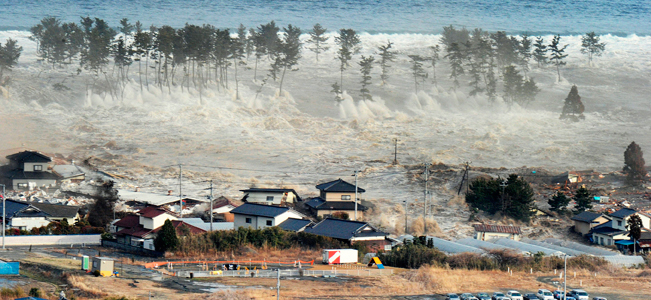
A magnitude 8.9 earthquake slammed Japan's northeastern coast, unleashing a 13-foot tsunami. Floods damaged part of Iwaki, Fukushima Prefecture.

Tsunami sirens were sounded and coastal areas were being evacuated in Hawaii, where the first waves were expected to hit about 3 a.m. Friday.
The Hawaii-based Pacific Tsunami Warning Center has widened its tsunami warning beyond East Asia early Friday to include Hawaii, Australia, New Zealand, the entire U.S. western coast, Mexico and Central and South America and the rest of the Pacific Ocean.
Chip McCreary, the center's director, said tsunami waves have the potential to swamp coastal areas of all Hawaii's islands.
"What these waves look like is an elevation of sea level, where the sea level will rise above its normal level and stay high for 10 or 15 minutes before it starts to recede," he said. "As a result of this, in a tsunami wave, that water can flood the coast line and be a hazard to people and buildings on the coast."
The warnings cover an area stretching the entire western coast of the United States and Canada from the Mexican border to Chignik Bay in Alaska. In Alaska, a dozen small communities along the Aleutian Island chain were on alert.
"Everyone in that area knows, when you feel it, move - don't wait for a siren," said John Madden, director of the Alaska Division of Homeland Security and Emergency Management. The largest affected town is Unalaska, population about 4,000.
Residents in coastal areas across the Pacific from Hawaii to Guam were ordered to evacuate to shelters and higher ground. In Hawaii's tourist district of Waikiki, visitors were being moved to higher floors of their hotels. Meanwhile, residents were waiting in long lines stocking up on gas, bottled water, canned food and generators.
"We're preparing for the worst and we're praying for the best," said John Cummings III, spokesman for the Honolulu Department of Emergency Management.
McCreary said the threat will become clearer when the waves hit Wake Island and Midway.
"Tsunami waves, because of their long length, they wrap around our islands very efficiently," he said.
Readings have come in from deep ocean gages deployed since the 2004 tsunami in Banda Acha in Japan and around Wake Island.
The warning was issued Thursday at 9:31 HST p.m. Sirens were sounded about 30 minutes later in Honolulu alerting people in coastal areas to evacuate. About 70 percent of Hawaii's 1.4 million population resides in Honolulu, and as many as 100,000 tourists are in the city on any given day
In the Philippines, officials ordered an evacuation of coastal communities along the country's eastern seaboard in expectation of a tsunami following the 8.9-magnitude earthquake in Japan.
Disaster management officials in Albay province southeast of Manila say they ordered residents to move to designated evacuation sites that are at least 15 feet (5 meters) above sea level.
In Guam, authorities advised people to evacuate low areas of the U.S. territory and seek ground higher than 50 feet above sea level and 100 feet inland.
The Northern Mariana Islands, another U.S. territory, was also under the warning, and the Hyatt Regency in Saipan has moved guests to three highest floors of the seven-story hotel.
Hotel spokesman Luis Villagomez said the hotel had received about three tsunami warnings in the last year but no serious damage.
Australia was not in danger because it was protected by island nations to the north, including Papua New Guinea and the Solomon Islands, that would largely absorb any wave activity, said Chris Ryan, a forecaster at the National Meteorological and Oceanographic Centre, the Australian government agency that monitors the threat.
Tsunami warnings are issued due to the imminent threat of a tsunami.
Read more: http://www.nydailynews.com/news/world/2011/03/10/2011-03-10_tsunami_strikes_japan_after_major_earthquake_hits_off_northeastern_coast.html#ixzz1GHwCOHt0
Subscribe to:
Posts (Atom)